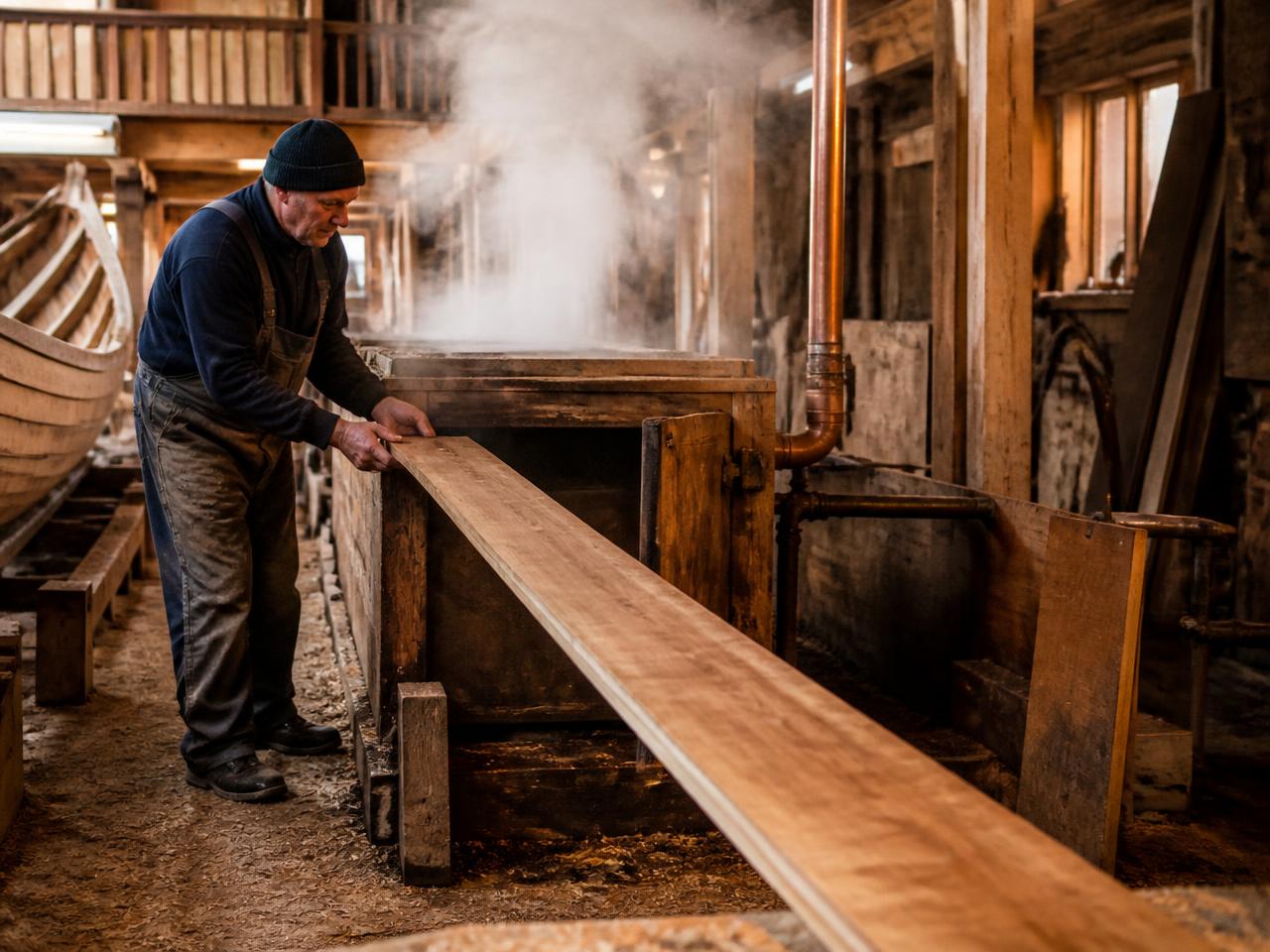
1. Build or borrow a steam box
The box only needs to do three things: hold the timber clear of pooling water, let steam reach every face, and trap enough heat to stay at 100°C. A length of PVC soil pipe capped at one end with a wooden door at the other is cheap and works well.
Drill a few small drainage holes along the bottom so condensation runs out instead of boiling the wood, and angle the box a degree or two downhill toward the door so water escapes the same way.
Put the steam inlet at the far end from the door so steam has to travel the full length. Confirm with a thermometer that the far end reaches 100°C before you load timber.
2. Prepare the timber
Air- or kiln-dried hardwoods bend far better than softwoods. Oak, ash, elm and iroko are the traditional choices for planks and ribs; avoid resinous softwoods, which tend to collapse under steam.
Rive (split) or saw the stock to finished size first. Steaming removes almost no material, so what goes in the box is what comes out. Remove sapwood that will not hold the curve, and plane a clean uniform thickness so it bends evenly.
Soak the timber in advance if it is at all dry. A plank that has been stood in water overnight bends with noticeably less checking than bone-dry stock.
3. Steam it long enough — but not longer
Rule of thumb: one hour of steaming per inch (25 mm) of thickness, measured across the smallest face you are bending. A 1-inch plank needs about an hour; a 1/2-inch rib needs roughly 30 minutes.
Start the timer when the box is genuinely at 100°C and steaming from every gap, not when you switch the steamer on. Under-steamed timber snaps; over-steamed timber turns punky and will not hold a crisp bend.
4. Bend quickly onto the form
You have only a minute or two of working time once the plank leaves the box. Have the form, clamps and straps already set up and within reach, and agree who is doing what before you open the door.
Pull the plank onto the form in one smooth motion. Do not stop halfway — a pause lets the fibres set in the wrong place and the timber will fight you, then crack.
Keep the tension face supported. If the curve is tight, use a backing strap (a thin steel or hardwood strip clamped to the outside face) to stop the outer fibres stretching and splitting.
5. Clamp and leave to dry
Clamp the timber firmly to the form at both ends and every change of curve. A spring-back of a few degrees is normal, so bend marginally further than the finished curve to allow for it.
Leave it clamped for at least 24 hours, ideally a few days, so the moisture equalises and the lignin re-sets in the new shape. Removing it too early is the most common reason a bend relaxes back.
Common mistakes
Steaming for too long, which breaks the wood down into a soft, weak sponge that never holds a curve.
Hesitating mid-bend. Steam-bending rewards a single confident pull; pausing almost always cracks the stock.
Ignoring grain run-out. Planks whose grain runs off the edge will split along that line no matter how well they are steamed — pick clean, straight-grained stock.